

The Problem with Starting from Detail
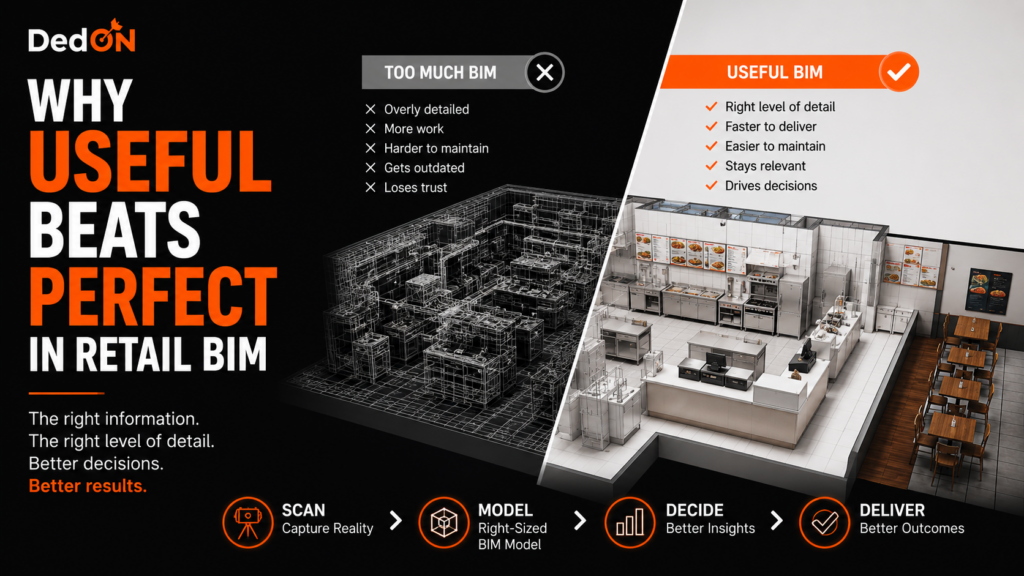
If you start a BIM strategy by asking, “How much information can we build into the model?” you’re already off track.
Because more detail doesn’t create more value.
It creates more work.
More to capture.
More to model.
More to maintain.
And that last part is where things fall apart.
The more complex your model becomes, the less likely it is to stay aligned with reality. And once a model stops reflecting reality, it stops being trusted.
At that point, it’s no longer a system.
It’s just a snapshot from the past.
What Actually Matters in a QSR Environment
Take a QSR renovation survey as an example.
You could build a highly detailed BIM model of a kitchen, every fryer, every component, every connection.
But ask a simpler question:
What does the organization actually need to know?
If you have a fryer, and you know it’s an R3000 model, the organization already knows everything that matters:
- Power requirements
- Maintenance procedures
- Replacement parts
- Lifecycle expectations
You don’t need to model every bolt.
You need to know what’s there.
Where Scan to BIM Actually Creates Value
This is where scan to BIM becomes powerful.
Not because it creates more detailed models.
But because it allows you to create the right level of model, faster and more reliably.
With a QSR renovation survey + scan to BIM, you can quickly build a model that answers the questions that matter:
- What equipment exists at this location?
- What are the key dimensions that impact layout?
- What needs to be replaced, reused, or reconfigured?
That’s it.
You’re not building a model for visualization.
You’re building a model for decision-making.
The Hidden Cost of “Too Much BIM”
Overbuilt models don’t just take longer upfront.
They create long-term friction:
- Slower field capture
- Higher modeling costs
- More effort to update
- Lower likelihood of maintenance
And eventually:
- The model stops being used
- The data becomes outdated
- The entire system loses credibility
All that detail becomes wasted effort.
Not because it was wrong.
Because it was unnecessary.
A Better Way to Think About BIM
A practical BIM strategy starts by reversing the problem.
Not:
“How much detail can we build?”
But:
“What decisions do we need to make, and what information supports them?”
From there, you build the simplest model that can answer those questions with confidence.
Nothing more.
Start Where Your Organization Actually Is
If you’re starting from scratch, keep it simple.
A base BIM model for a QSR might include:
- Building geometry
- Core equipment (with model identifiers)
- Key brand elements (counters, seating, signage)
- Critical dimensions
That’s enough to support:
- Renovation planning
- Maintenance decisions
- ADA and compliance reviews
- Portfolio-level analysis
You don’t need perfection.
You need usefulness.
The Real Test of a BIM Strategy
A BIM model only has value if it stays relevant.
That means one thing:
It has to be maintained.
And here’s the reality:
The more complex your model, the less likely that is to happen.
So the goal isn’t to build the most advanced model.
It’s to build a model your organization can actually use and sustain over time.
BIM isn’t about creating a perfect digital twin.
It’s about creating a system that helps you make better decisions, again and again.
And in retail, especially in QSR environments, the teams that win aren’t the ones with the most detailed models.
They’re the ones with the most useful ones.